HomeMy WebsiteAbout mePocket PatchworkFreebie Patterns

Showing posts with label 1800's Trivia. Show all posts

Tuesday, November 3, 2015

1800's Trivia ~ The Spill Keeper

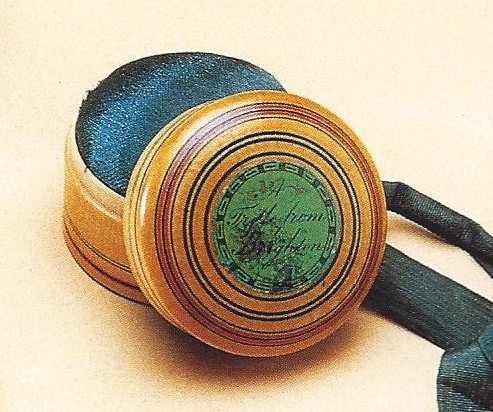
I've received quite a few emails inquiring about the mention of a Spill Keeper in my profile article of American Patchwork & Quilting magazine (Dec, 2015).  In the 'What Is Treenware' inset (pg 20), the writer gave a few clues as to its purpose, but because of space, a photo was not included.

My Spill Keeper sits atop one of my favorite antique finds, the horizontal spice box, and is the little blue box at the far right.

In this close-up, you can see it a little better.  It's about the size of a deck of cards.  
This dear piece of carved treenware has three compartments, and a hand carved little spoon.  Pioneers would save little bits of flammable scraps and materials of any kind, such as threads and fabric, lint and leaves that could be used in starting a fire.  The bits would be placed in one of the compartments, and the spoon would crush and compact the bits.  

When holding the Spill Keeper as our pioneering ancestors would, you can see how the blue paint has been worn away from two grasping fingers, giving it a little more character, in my humble opinion.  
Why it's called a Spill Keeper I don't know.  It's likely a term lost to the past, just as the need for a one is.  It remains an artifact of nineteenth century living, and yet another tangible relic of their frugal lifestyle.  

We are so spoiled and blessed in many ways.  I think, though, maybe they would look at us with our many conveniences and think, perhaps, that life is way too fast in the twenty-first century...so, no thanks..... they'll keep their simpler way of life.  Fun to ponder, isn't it?!  
This photo was sent to me by Angie Roberts, shop owner of The Noble Quilter in Elk River, MN.  These lovely ladies are some of the women in the shop's Prairie Women's Sewing Circle club.  As you can see by the wonderful display of quilts before them, they are quite an active group!!  Awesome job, my fellow Prairie Women!!  Your quilts are just lovely!!  Thanks, everyone, for sharing your talents with us.  

Don't forget....Friday, November 6th is the final installment of my 
Tucker Pocket Patchwork Sew-Along!!  
I'm so excited!!  

Friday, November 21, 2014

Introducing Treenware & Berries!!


I'm so pleased to announce my next fabric line with Marcus Fabrics called.......

Treenware & Berries

Before I start showing you the new fabrics in this collection, perhaps a little history is needed on what the term "treenware" is all about.

The photo above shows a sample of some of the early American treenware I've collected.  Basically, treenware is (an umbrella term for) any household item that was made, carved, or whittled from wood...in essence from a "tree".  Think...household items made from a tree.

Early American treenware is plentiful and easily found in antique shops.  Some items very affordable, and some much more expensive.  Most common are cutting boards, both plain and fancy, spoons, ladles, paddles, butter presses, bowls, plates, dough bowls, rolling pins, highly sought after noodle boards, graters, and innumerable kitchen utensils.  

Treenware items were put to hard work.  They weren't meant to sit on a shelf looking pretty.   They were put to good use everyday.  While most are very plain and utilitarian in design, sometimes their maker put a little extra creative spin in the design.  These butter molds, for instance, do have a specific purpose.  The size of the mold pressed a specific weight of butter, while the pressed design marked the brand, if you will, of the butter maker.  Each one hand carved.... a work of art.  What luck it was to find a mini butter press with my initial!  

Here are a few of my antique graters, all treen, and some with original paint.  Each one hand made.  As you can see, the red one doesn't have much in the way of design (you know me with the color red, AND original paint!!  Swoon!), but the black one, albeit quite worn, shows so much character and design, and was obviously worn and loved.  

The most highly prized (highly priced!) and collectible are treen items in original paint.  I love most all of the original paint colors you commonly see which are whitewash or cream, blue, red, green, black and mustard.  My wallet doesn't often allow adding to the 'original paint' collection!  You know how that is!

So now that you know what treenware is....why use that name for the fabric collection?  Well....I love using terms from the nineteenth century, and this collection has lovely, warm browns, a few reds, and luscious creams.  Basically brown and red.....Treenware and Berries!


Here's a little sneek peak at a few of the fabrics in the Treenware & Berries collection.

I'll show you the entire line in my next post!  Have a good weekend!!

Monday, February 24, 2014

1800's Trivia Quiz ~ Answers

Family living near Broken Bow, NE 1888.  Used with permission: Nebraska Historical Society
1800's Trivia

So, how do you think you did?  I won't keep you in suspense any longer.  Here we go.....

1). By Hook and Crook  

Well, this is something we still say, but the meaning we use, which loosely means "doing whatever it takes" is not at all what was meant in the 1800's.  It was actually a legal term which forbade a tenant to chop or cut down a live tree anywhere on the property.  The tenant could, however, pull-down, or "hook" the dead limbs and use them for firewood.

2).  A Grike

I don't think I've ever heard of this word before.  It refers to a narrow opening in a stone or wooden fence, allowing people to get through, but not any of the farm animals.  Do we have any farmers or ranchers out there who have heard of this word?  I would love to know!

3).  Made by Cat and Clay

This is an interesting phrase that refers to a construction method which uses sticks and mud in the construction of a building.  I can't help but wonder exactly how that phrase came to be!  Was a feline involved somehow?  I suppose we'll never know!

4).  A Trunnel

A trunnel is a large wooden pin used in fastening the framework of buildings together.  They were also commonly known as "tree nails".  Hhmmm....wouldn't you love to see one of those?

5).  A Summer Cloth

Ok...this one really piqued my interest.  As a quilter and fabric lover, this could have had all sorts of domestic applications, right?  It was an all-purpose square of water-tight canvas that could be folded into knapsacks, a water bucket and many other uses.  What does the word "summer" have to do with that?  

Hope you enjoyed this little quiz.  I love this stuff!

P.S.  Mary M. left me a comment in my last post about the family in the photo above.  She remarked about all of the household stuff they had in the photo and asked if there was any significance to it.  Absolutely, YES!  Like now, for instance, we might have our photos taken in front of a new car.  Back then, they were equally as proud of their home, livestock, wagon, and for sure, treadle sewing machine.  It was a status symbol for them.  This photo was taken by famous photographer, Solomon Butcher, who traveled extensively throughout the prairie states taking photos of pioneer families and their precious belongings.  You can learn more about Mr. Butcher at your local library.


Saturday, February 22, 2014

1800's Trivia Quiz


Family living near Broken Bow, NE 1888.  Used with permission Nebraska Historical Society
Well, it's been a busy week working on new designs, filling orders, and the usual.  Not anything fun to blog about right now, but I always find some fun stuff from the nineteenth century to share with you.  How about a quiz?  

1800's Trivia

There were names and phrases pertaining to objects or activities used in everyday life in the 1700 & 1800's that are now obsolete.  I'm wondering if you'll know the answer to some of these questions.  It's interesting, if nothing else!   Ponder the meaning of the following words and I'll tell you what they really were in my next post.  No fair Googling the answers!!

In the nineteenth century, what was the meaning of.........

1).  By hook and crook

2).  A Grike

3).  Made by Cat and Clay

4).  A Trunnel

5).  A Summer Cloth

Fun stuff!  Answers in my next post.  Enjoy your weekend!


Monday, February 10, 2014

What's In A Name?

It's been too long since my last blog post.  I've been thinking about all of you, and wanted to post, but I was in serious design mode for the last ten days or so, working on new fabric collections, and quilt designs.  My next collection is already well under way, and I submitted a new one last Friday.  All that new stuff is something I can't yet share with you, so that meant not as many blog posts while I was working on it all....But...it also means new fun stuff to look forward to!

Now that the bulk of that design work is over, I will be working to wrap up a few things that have been works-in-progress, and those I can share with you later this week.  

For now, however, I have some fun trivia to share.  When I'm reading about life in the 1800's for the Prairie Women's Sewing Circle club, I often come across great information that isn't really suited to the club, but is rather fascinating, to me anyway, and I thought perhaps you'd enjoy it, too.

1800's Trivia
What's in a name?  Back in the day, your last name could say a whole lot about what you did for a living.  With a last name of Miller, Potter, Wheeler, Carpenter, Weaver, Baker or Taylor, you knew his profession.  But...what if your last name was Cooper?

A cooper was a tradesman skilled in the art of making a wide variety of wooden, leak-proof (both wet and dry) containers.  His craft provided items that were very necessary to early American living, such as buckets and pails, firkins, butter churns, and barrels.  The earliest settlers brought coopered items with them as storage containers for any number of things.  

Barrels large and small held liquids, and of course, are still used today for wine and other spirits. Butter churns, like mine, may still be used today, but not so much!  Thank goodness!  

Quilt design is Fritzie's Closet pattern by Heartspun Quilts
Among the most collected items are firkins and buckets.  Basically, a firkin (Dutch origin) is a bucket with a cover.  The term, firkin, originally meant one-fourth of a barrel, but later in the nineteenth century after firkins were made in numerous sizes, just simply meant a covered bucket.

All of these items are highly collectible by those of us who love colonial living.  Having a grand stack of firkins in graduated sizes is a prize collection.  For me, firkins (and any treenware) with original paint is a real prize!  Especially those with a lovely patina of wear showing it's years of service.

Hope you enjoyed reading about a little known profession that has deep roots in early American living.  I think these hand-made items are a true American treasure!  Stay warm and cozy....it's cold out there!


Wednesday, October 30, 2013

Mourning Jewelry

Here is a fantastic bunch of 1800's trivia.......

I'd like you to meet Carol Miller.  We met on my visit to the Des Moines Quilt Guild when she attended a couple of my workshops.  I got to talking about what life was like for ordinary prairie women in the 1800's (what a surprise...I know!) and Carol told me about her passion for mourning jewelry.  I had read all about mourning jewelry in Early American Life magazine (Feb 2004 issue) but had never seen any in person.  Carol offered to bring her collection to class the next day.  We had no idea what a special display we were in for!

Early American Life magazine tells us that mourning jewelry arrived in America with the colonists, but it was in 1763 that New York jeweler, Charles Olivier Bruff, hired a London hairworker to create mourning jewelry with hair of the deceased worked into the pieces.

At first, the hair was tightly woven and/or braided and inserted in the back side of lockets and brooches, or placed in the back of framed portraits.  Gradually, the hair designs were moved to the front of the jewelry pieces for a more visible presence.   Mourning jewelry became so popular, that long before he died, George Washington cut and saved locks of his hair for his wife and family.  A mourning ring, circa 1800, and a miniature pendant with George's hair (belonging to Martha) is part of the collection at Mount Vernon. 

Hard to believe that this piece in Carol's collection isn't swirls of paint, but is in fact hair!  This is the earliest piece in her collection, dating from sometime in the 1700's.   All of the motifs inside the pin were formed from hair.  

As you can see, these pieces say "In Memory Of" and have locks of hair in the center cabochon.
The hat pins have hair in them as well.

 In this photo, all of the dark and medium brown braiding and roping is real hair!  See the earrings on the left with the open weave in the middle....all hair work!  (The woman in the photo is wearing a pair of earrings exactly like those!)  The medium brown interlocking piece at the bottom of the photo with the gold plates is all made of hair.  It was worn by a man around this upper arm as a remembrance of his departed wife.  

Again...all the twisted and braided pieces are hair work.  Note the round pendant mid-way on the right that has a bit of blue, beige and red.  Carol told us that the blue is blonde hair that turns that color over time....making brown hair more desirable.  Who knew blonde hair would turn blue?   The long piece just under the locket was made for a man using his wife's hair.  He used it to secure his pocket watch, and therefore, could touch his wife's hair when looking at his watch.  

Here's a closer look at the braiding and different twists of the hair.  Isn't the locket lovely?

Carol volunteers at a local living history museum and demonstrates how mourning jewelry is made.  She uses horse hair, but has made a few pieces using her own hair.  Most of us may not be looking for mourning jewelry made from our deceased loved ones locks, but knowing about this 1800's tradition is a good thing.  Getting a chance to see it in person was really great as Carol has a wonderful collection.  

My heartfelt thanks to Carol for taking the time to share her collection with all of us!  

Thursday, August 29, 2013

Buggy Barn T-Shirt winner!


And, the winner is..........

Hiyacinth......who commented:
        
"Well, since this is a dream, I'd like to go to Pour l'Amour du fil in France -- see the show, shop     and take some classes.  Or, if that doesn't work out, how about a retreat in Australia?"

Congrats, Hiyacinth, I like how you think!  If you're gonna dream, why dream big!!  I'd love to go to those places, too!!  Please email me with your address so I can get your Buggy Barn T-shirt on its way to you!  

My thanks to all who took the time to comment!  I L.O.V.E. reading your comments each and every day, and you had some wonderful memories to share.  


I'm thinking it's time for a bit of.....

1800's Trivia

Do you know what a "Pin Poppet" is?


A Pin Poppet is a type of vintage pin cushion whereby the cushion is held within a container that has a top or lid, which unscrews to reveal the pins inside.  Kinda cool, huh?

See you tomorrow for another block in my Nabby's Dowry Sew-Along!

Sunday, December 2, 2012

A Very Old UFO


A few weeks ago when we were antiquing, this sweet little sampler was one of the things I purchased and I wanted to share it with you.  It's a Schoolgirl's sampler, and obviously she was still working on it.  It was still in the hoop when I bought it.  Notice that the hoop doesn't have any screw or other device to tighten it.  While the sampler itself is a treasure (I adore and collect old samplers when I find them), it was when I turned it over that it stole my heart, and I instantly knew I just had to have it.


In order to create the needed tension between the two hoops, several pieces of beige cloth have been wrapped around the inside hoop, then stitched in place.  What a wonderful make-do find!  The top hoop really isn't all that tight against the inside hoop.  It barely gives a bit of tension to the linen.  I wonder how many pieces of linen have been in between these hoops?  Perhaps a mother and her daughters all used it?  The hoop itself has a lovely feel and the patina is glorious from wear.  I suppose most people would pick it up and put it down without a thought.  But, as you know, my mind and heart live in the prairie most days, and this unfinished sampler in its old hoop instantly transported me back to the 1800's. 

Truth is, I could go on and on as to why this speaks to my heart, but I won't.  I'm thinking that for many of you, you know exactly what I mean.  Do you have any items from the past that touch your heart?

*~*~*~*~*~*~*~*~*~*~*~*
1800's Trivia


The Prairie Diamond
 
 
Sherry K., who is one of the ladies in my Prairie Women's Sewing Circle club, brought me this "Prairie Diamond" ring.  She told me that, in the 19th century, especially when immigrants were headed west to homestead the prairie, sometimes when they became engaged to marry, the young man would fashion an engagement ring from a nail, bending the nail into a ring for his beloved to wear.
 
Now that's really making-do!!
 
Enjoy your day and thanks for stopping by.....Pam

Thursday, November 8, 2012

Off and Running Again!

Hello, Dear Readers!

I am back home from my wonderful trip to Indiana.  I arrived at Back Door Quilts Tuesday afternoon and spend a few hours there pouring over every nook and cranny full of delicious quilty things.  It was my first time there and I had plenty of time to linger and take it all in.  Then, I spent Tues evening and all day Wednesday with the ladies from the Bloomington, IN Quilt Guild.  I took lots of photos for you to enjoy and had every intention of posting them today, but time just got away from me.  I'm only home for 24 hours before I head out on another adventure.  This time, my pals and I are headed to a big Folk Art & Antiques Festival downstate, and immediately after that....I escape to another friends lake home to sew, sew, sew.  I promise to blog promptly once I'm home to stay.

In the meantime, I thought you'd enjoy a bit of...

 1800's Trivia!


Sparking Lamps
 
Sparking lamps were popular in the early 1800s for monitoring the length of time a gentleman caller could spend with the object of his affections.  The young man was permitted to remain in the woman's home for as long as the lamp remained lit.  Sparking lamps were made in a wide variety of sizes with some so small they held only a thimble of oil.  If the folks didn't like the gentleman when he came a'courting, they could pull out the smallest lamp, and when that thimbleful of fuel was gone, he was out the front door!
 
 
Have a wonderful week.....I'll be back soon....
 
Pam


Tuesday, September 18, 2012

Journey Four is Finished!!

 
Yippee!!! I'm doing a dance of J.O.Y. because Journey Four is completely
finished!!  Each Journey is jam-packed with so much information that I feel like
I've written a dissertation, and now I'm out for summer vacation!
 
I know loads of Prairie Women all over the world have been waiting for
Journey Four to be ready....and ready it is!!
 
 
I had the best time choosing the subjects for the six historic stories.   So fun!
My, the good people who lived on the prairie in the 1800's sure had a life full of
lots of work.  I can't imagine they had much down time.  Hhmmm....seems we
can say that now as well....except whether we have enough to eat during the
snowy winter doesn't depend on what we do now during harvest time!
We have it much easier!! 
 
The front cover shows the one throw sized quilt in the collection, and the
back cover shows the remaining five do-able, affordable smaller projects.
There are two bonus projects in Journey Four as well.
 
The Prairie Women's Sewing Circle is available only through participating
quilt shops!  Email me if you'd like a list of participating shops in your state,
or a referral to a shop offering membership-by-mail! 
 
*~*~*~*~*~*~*~*~*~*~*~*~*~*~*~*~*~*~*~*
Forget Me Not Sewalong 
 
In my last post, I gave you the last two blocks in the sewalong, and asked for comments
about which blocks were your favs, and which ones were not.  A lot of you really
liked blocks 7 & 8.  I happen to like them all and don't really have a favorite. 
I just love a sampler quilt for that reason. 
 
The winner of the contest is......
 
Grannie Smith...who wrote....I have loved loved loved making all the blocks. I can't pick a favorite but I love the fact that block 12 will be my label AND it will be on the front...I won't have to make a separate label for the back. Laurie in Utah
 
Laurie...please email your snail mail address and choose a Heartspun Quilts pattern prize!
 
You know...the Forget Me Not sewalong isn't over yet!!  There are still
two parts coming.  This Friday, you'll receive the piecing instructions for the setting,
with the BIG REVEAL of the finished quilt coming Friday, Sept 28th!!
 
Many of you have emailed me to ask if I will have another sewalong....and the answer is....
 
Yes!
 
It will be a couple of months yet....so stay tuned!
 
*~*~*~*~*~*~*~*~*~*~*~*~*~*~*~*~*~*~*~*
 
The Heirloom scissors are now back in stock, and a limited number of
Fat Quarter and Fat Eighth bundles of my Heart of the Prairie fabric collection
should be back in stock next week. 
 
*~*~*~*~*~*~*~*~*~*~*~*~*~*~*~*~*~*~*~*
I want to start sharing bits and pieces of 1800's trivia with you.  I adore
early American history, and while I'm researching stories for the
Prairie Women's Sewing Circle club, I often find tid-bits that are
fun, and I thought you'd enjoy them too!
 
My friend and fellow Prairie woman, Cheryl B, brought a bit of  personal nostalgia 
to a recent PWSC meeting.  Her mother collected thimbles, and kept index cards
with notes about the thimbles she had, what family member they belonged to, and some thimble history.  I asked her if I could share the information with all of you, and she was happy to share.
 
Cheryl's mother, Winifred, wrote....
 
Once upon a time every little girl was given a thimble for children were taught to sew and stitch a sampler at a very early age.  Most of these thimbles when found are in good condition as little fingers outgrew the thimble.  Also, girls on confirmation received as a gift a thimble -
so that she might get started on her hope chest. 
 
I have a "pudding" thimble.  It was put into a Christmas pudding in England,
and the person who got it was supposed to have the best luck all year.
 
Thimbles, or thumb-bells (originally they were worn on the thumb) date back to antiquity.  No one knows for sure who invented the first one, but it was probably someone who sewed and said "Ouch".
 
Thimbles come in all mediums: aluminum,bone, china, brass, copper, cut glass, gold, horn, ivory-scrimshaw, leather, pewter, plastic, porcelain, steel, sterling, stone, etc.
 
They are: carved, embossed, enameled, engraved, filigree, filleting (bands), gadroon(a series of raised decorative curves as adornments), hand painted, jeweled, moulded, stamped, and two-toned.
 
There are thimbles with jeweled tops, magnetic tops, open tops, razor on the side for cutting thread, needle threaders on the side and looped.
 
Wow...who knew so much could be done to something so tiny?
 
Until next time.....
 
Pam